





perfect trip!
The Best Cycling Tours in Italy for Wine Lovers (With Routes Through Barolo, Prosecco and Chianti)
Italy has 20 wine regions, hundreds of DOC and DOCG designations, and a landscape that rewards cyclists: rolling hills, quiet country roads, medieval villages spaced just far enough apart to give you something to pedal toward.
The best cycling vacations in Italy aren't just about the kilometres. They're about arriving in Alba during truffle season, following the Strada del Prosecco through a UNESCO World Heritage landscape, or coasting down into Greve in Chianti, where the wine culture of the region is never far away. The routes below do exactly that, and all of them are available as self-guided itineraries through Italian Bike Tours, so you ride at your own pace with luggage transferred hotel to hotel.
Here are the wine cycling routes in Italy worth putting at the top of your list.
Piedmont: Cycling the Barolo Wine Hills (8 Days)
The Langhe hills of Piedmont are the heartland of Barolo, Italy's most celebrated red wine, and pedalling through them is a genuinely distinctive experience: castle towers rising above vine-covered slopes, the Alps visible on clear days, and trattorias where the house wine is taken as seriously as the food.
The Piemonte: Tra le colline del Barolo tour (ITSB030) runs for 8 days with 6 days in the saddle, starting and finishing in Alba. It's one of the best bike trips in Italy for serious food and wine lovers.
What you'll ride through
The route loops through the Langhe and Monferrato hills at a moderate to challenging level. Key stages include:
-
Alba to Barolo (Day 2, 48 km): The Enoteca Regionale del Barolo in Barolo castle is one of the best places in the region to taste the wines of the Langhe. The WiMu wine museum in the same castle is worth a stop.
-
Benevello loop (Day 3, 31 km): An optional extension climbs to Mombarcaro at nearly 1,000 m, with panoramic views over the Langhe.
-
Acqui Terme to Asti (Day 6, 53 km): Asti is the home of Asti Spumante, and the route passes through the vineyards that produce it.
Beyond the wine
Piedmont is the birthplace of the Slow Food movement, and the food here is taken as seriously as the wine. Expect bagna cauda, tajarin pasta, and the white truffle of Alba, which appears on menus from October onwards. This is one of the few regions where the food genuinely rivals the wine for attention.
Who it's for: Cyclists comfortable with hilly terrain and daily stages ranging from around 30 to 55 km. The rolling Langhe landscape means regular climbs. E-bikes are available if you want to take the sting out of the ascents.
View the Barolo cycling tour and request a quote →
Veneto: The Prosecco Route (7 Days)
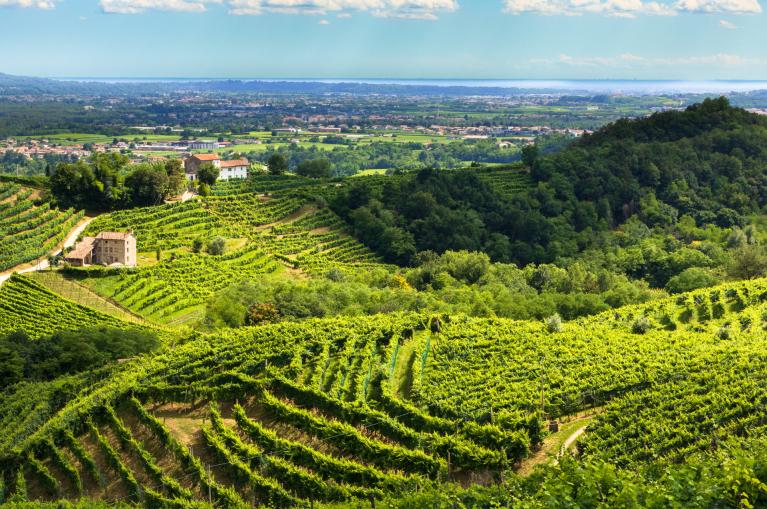
In 2019, the Conegliano-Valdobbiadene Prosecco hills became a UNESCO World Heritage Site. Cycling through them, it's easy to understand why. The terraced vineyards, the pale green of the Glera grape vines, the Dolomites rising in the distance: it's one of the most beautiful cycling landscapes in northern Italy.
The Veneto: Le colline del Prosecco tour (ITSB100) covers 7 days with 5 days of cycling, starting in Castelfranco Veneto and finishing in Treviso.
The route
The itinerary follows the Strada del Prosecco from Valdobbiadene through the heart of the wine zone, with a detour to Bassano del Grappa. Daily distances run from 30 to 48 km, with the terrain getting hillier as you enter the wine country proper.
-
Bassano del Grappa (Day 2, 40 km): The Poli Museum of Grappa is free to visit. The Ponte Vecchio over the Brenta river is one of the most photographed bridges in the Veneto.
-
Valdobbiadene to Pieve di Soligo (Days 3-4): The core Prosecco zone, with wineries along the road offering tastings. The village of Santo Stefano is a highlight.
-
Molinetto della Croda (Day 5): A 17th-century watermill still in operation, set among vineyards.
Why the Prosecco hills work so well for cyclists
The road from Valdobbiadene to Follina winds through the vineyards at a pace that rewards stopping. On a bike, you can pull over at any cantina without disrupting the day's plans. The hills add a satisfying degree of challenge, and e-bikes are available for those who prefer extra support on the climbs.
Best season: April to October. The harvest (vendemmia) in September is spectacular, with the whole region alive with activity in the vineyards.
View the Prosecco cycling tour and request a quote →
Tuscany: Florence to Siena Through the Chianti Classico Zone (4 Days)
Chianti is probably the most famous wine cycling route in Italy, and the reputation is deserved. The road between Florence and Siena passes through the heartland of Chianti Classico, the DOCG zone that produces the Gallo Nero (Black Rooster) wines.
The Firenze & Siena, tra le colline del Chianti tour (ITBM105) covers 4 days with 2 days of cycling, connecting two of Italy's most celebrated cities across the vine-covered hills between them.
What you'll ride through
The route is compact but well-chosen. Key stages:
-
Florence to Greve in Chianti (Day 2, 32 km): The route passes through Impruneta before arriving in Greve, the main market town of the Chianti zone. Le Cantine di Greve in the town centre offers a wide selection of Chianti wines for tasting.
-
Greve in Chianti to Siena (Day 3, 52 km): The route continues south through Radda in Chianti, one of the best-preserved medieval villages in the region, before the final descent into Siena and the extraordinary Piazza del Campo.
Why it works as a cycling tour
The Chianti Classico zone sits between two major cities, which means the infrastructure is excellent: good roads, well-spaced villages, and a density of wine estates that means you're rarely far from a cellar door. The landscape is varied and genuinely beautiful, with cypress-lined hilltops and views that change with every bend in the road.
View the Tuscany Chianti cycling tour →
Emilia-Romagna: The Food Valley Cycling Tour

If Piedmont is about wine with food as a close second, Emilia-Romagna reverses the order. This is the region that gave the world Parmigiano-Reggiano, Prosciutto di Parma, Mortadella, Lambrusco and balsamic vinegar of Modena. The Food Valley cycling tour from Modena to Parma is a gastronomic journey on two wheels.
The route follows the Via Emilia, the ancient Roman road that runs through the Po Valley, connecting towns that each have their own speciality. Modena has its aceto balsamico and the Ferrari museum. Parma has the ham that carries its name and one of the finest opera houses in Italy.
The wine angle
Lambrusco is central to the region's gastronomic identity: dry, tannic and deeply coloured, it pairs particularly well with the local salumi. Drinking it in a trattoria in Modena with a board of cured meats is one of the essential food experiences of Emilia-Romagna.
The terrain here is flatter than Piedmont or Tuscany, which makes this one of the more accessible cycling vacations in Italy for riders who want to cover distance without too much climbing.
Combine it: The Food Valley tour pairs well with a few days in Bologna, one of Italy's best cities for eating and a natural gateway to the region.
View the Food Valley cycling tour →
Sicily: Coasts, Temples and Marsala (7 Days)

Sicily is the unexpected choice for a wine-focused cycling vacation in Italy. Most people don't think of it first, which is precisely why it's worth considering. The island has a long winemaking tradition, and native grape varieties such as Nero d'Avola, Grillo and Catarratto are central to its wine identity.
The Sicilia: Coste e Templi tour (ITSB140) covers 7 days with 5 days of cycling, combining coastal roads, the ancient Greek ruins of Selinunte, the salt pans of Marsala and wine tastings in western Sicily.
Marsala and the western wine zone
The route passes through the Marsala wine zone, where the fortified wine of the same name has been produced since the 18th century. Tasting Marsala locally reveals the full complexity of the wine. The dry versions, aged in wooden casks, are particularly worth seeking out.
The salt pans between Marsala and Trapani are one of the visual highlights of the route: ancient windmills, shallow lagoons, and the kind of light in the late afternoon that makes everything look slightly unreal.
What else the route covers:
-
Favignana, a small island off the Sicilian coast
-
Selinunte, one of the largest Greek archaeological sites outside Greece
-
Coastal roads along the western shore
Season note: Sicily works best as a cycling destination in spring (April-May) and autumn (September-October). Summer temperatures are high.
View the Sicily cycling tour →
How to Choose the Right Wine Cycling Tour for You
Any of these routes will give you a more grounded understanding of Italian wine than a cellar door tour, because you're experiencing the landscape that produces it rather than just the bottle. Here's a quick guide to which suits which kind of traveller:
-
Barolo (Piedmont, 8 days): Serious wine lovers and Slow Food enthusiasts. Hilly terrain.
-
Prosecco (Veneto, 7 days): Scenic landscape and moderate cycling. Rolling hills.
-
Chianti (Tuscany, 4 days): Classic Tuscan experience, history. Hilly terrain.
-
Food Valley (Emilia-Romagna): Food-first travellers, flatter terrain. Flat to gentle. [CHECK TOUR DURATION]
-
Sicily (7 days): Off-the-beaten-track, archaeology. Flat coastal roads.
All of these are available as self-guided tours, meaning you cycle independently with a route map and GPS navigation app, while Italian Bike Tours handles hotel bookings, luggage transfers and emergency support. You set your own pace and don't need a fixed group or guide.
E-bike options are available on many of our tours for riders who want to cover the same ground with less physical effort.
Planning Your Cycling Vacation in Italy: What to Know
A few practical notes before you book:
When to go: Spring (April-May) and early autumn (September-October) are the sweet spots for most of these routes. The harvest season in September and October adds an extra layer of atmosphere in wine country. Summer works well for northern routes like the Prosecco hills and Piedmont; in Sicily and Tuscany, spring and autumn generally offer more comfortable cycling temperatures than July and August.
What's typically included: Italian Bike Tours' self-guided packages cover hotel accommodation with breakfast, luggage transfers between hotels, a detailed route book and GPS tracks, and emergency support. Bike rental is available separately. Check each tour page for the specific inclusions.
Fitness level: These tours cover a range of difficulty levels. The Food Valley route is among the most accessible, with flatter terrain and manageable daily distances. The Barolo hills offer a more demanding ride, with regular climbs throughout. Most tours are suitable for cyclists comfortable with 30–50 km per day; check each tour page for the specific difficulty grading.
Booking: Italian Bike Tours works on a quote-based system. Request a quote through the tour page, specifying your dates and group size, and they confirm availability and pricing. Early booking is recommended for peak season dates.
Browse all Italian Bike Tours' gastronomic cycling routes →
Written by the Italian Bike Tours Team





Tour types
Touroperating
S-Cape Countryside Travels srl
Borgo Allegri 16R
50122 Florence FI • Italy
VAT Nr. IT05227330486